
Idempotency
Idempotency
- Last updated
- Jul 16, 2026
- Relationships
- 6
Mental model
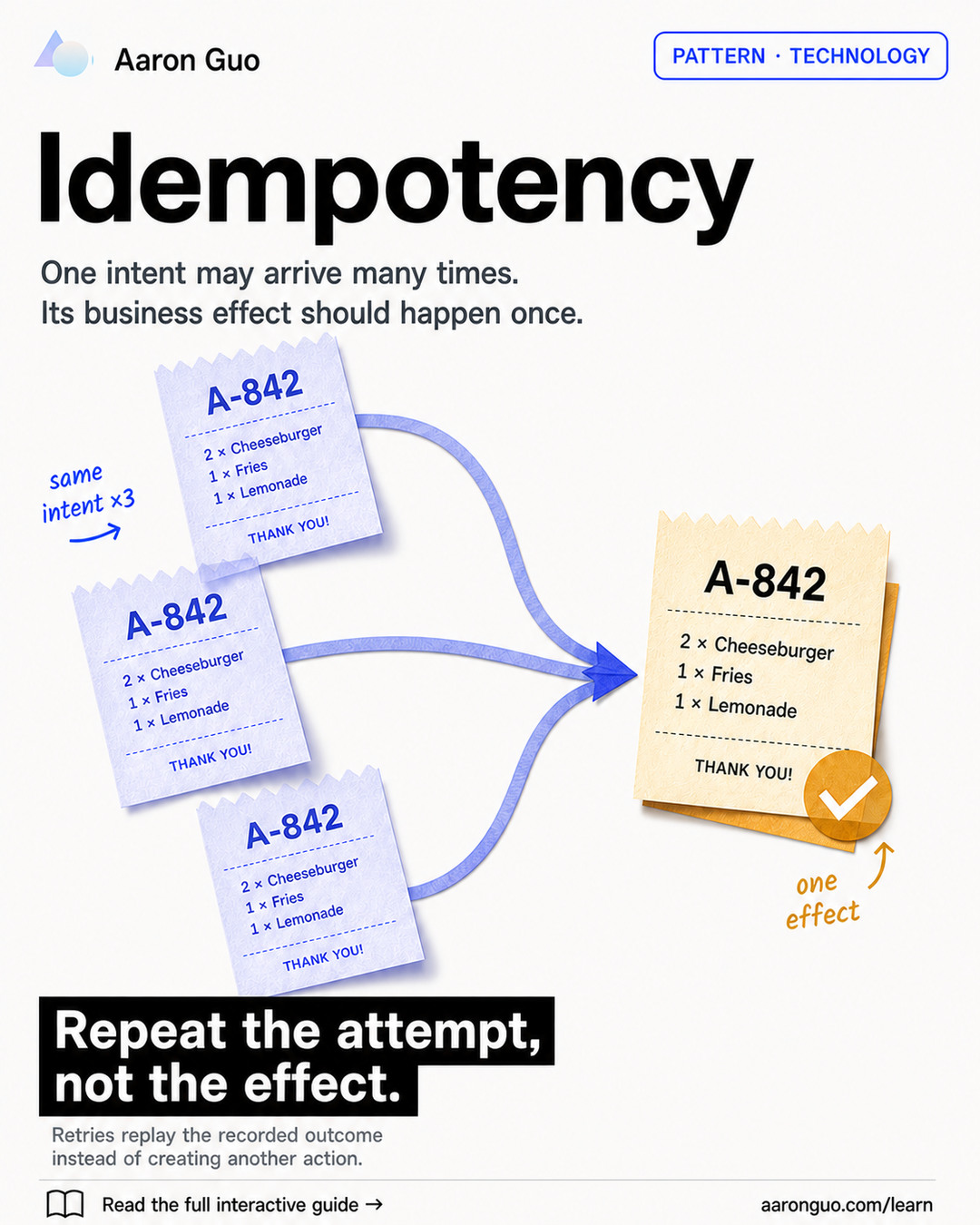
The same intent may be delivered many times; the system creates the business effect once and replays that outcome to retries.
Visual memory card
The pattern, in one image.
A compact visual makes the pattern easier to recognize when it appears in a different example.
01 · Unknown-outcome lab
The charge succeeded. The response disappeared.
The client has no proof of success or failure. Step through its retry with and without a stable identity for the business intent.
A $42 payment is ready to send.
No request has arrived.
No payment record.
02 · Key contract
A key is useful only when the uncomfortable cases have rules.
Choose a case. The important design work happens around identity, atomic ownership, concurrency, and time.
Same caller · same key · same parametersA retry is recognized by intent, not by arrival count.
03 · Operation judgment
First ask whether the operation can converge by itself.
Natural idempotency is simpler than a ledger. Relative changes and external effects need an explicit protocol.
SET status = PAIDNaturally idempotentEvery repetition converges to the same named state.
DELETE document 42Naturally idempotentResponses may differ, but the resource remains absent.
POST create paymentNeeds an intent keyA repeated creation is a new charge unless retries share identity.
balance = balance + 10Not naturally idempotentEvery execution changes the state again.
04 · Concept neighborhood
Do not confuse recovery, detection, delivery, and effect.
They work together, but each answers a different question. The relationship type is the useful part.
When should another attempt be made, and with what backoff?
Which attempts express the same business intent?
How are repeated deliveries detected or suppressed?
May a message arrive more than once so it is less likely to be lost?
How is a database change coupled to eventual message publication?
Can a scoped effect appear once even when delivery and execution repeat?
Idempotency
Idempotency solves the hardest kind of distributed-system failure: not a clear success or failure, but an unknown outcome.
A client sends a payment request. The server charges the card, but the response disappears on the network. The client sees a timeout. If it gives up, a payment that should complete may look failed. If it retries blindly, the customer may be charged twice.
An idempotent contract separates recovery from duplication: the request may be attempted again, but the same business intent does not create the business effect again.
A restaurant ticket
Imagine handing ticket A-842 to a kitchen and hearing no confirmation. You hand over the same ticket again.
- Without an order number, the kitchen may cook two meals.
- With a stable order number, it finds
A-842and returns the existing order status. - A genuinely new meal needs a new number.
- Reusing
A-842with a different dish should be rejected, not guessed.
The ticket is only an identifier. The kitchen still needs a reliable ledger, and recording the number cannot be separated from accepting the order by an unsafe gap.
Mathematical and system meaning
An idempotent function satisfies:
f(f(x)) = f(x)
In software systems, the useful definition is semantic: making the same request multiple times has the same intended effect as making it once. It does not require byte-identical responses or forbid extra logs, metrics, and timestamps.
For example, the first DELETE /documents/42 might return 204 and the second 404. The responses differ, but the intended state — document 42 is absent — has converged.
Two ways to get idempotency
Make the operation naturally idempotent
State assignment tends to converge:
SET order.status = "PAID"     repeated → still PAID
DELETE document 42            repeated → still absent
PUT /profile { name: "Li" }   repeated → same representation
Relative changes usually do not:
balance = balance + 10
toggle subscription
send welcome email
create a new charge
This gives a practical first question: can “change it again” be rewritten as “make it equal to this state”?
Add an Idempotency Key
Creating a payment, booking, or cloud resource cannot always be reduced to a simple assignment. The client can instead generate one stable key for one business intent and reuse it for every retry.
Idempotency-Key: order-842-payment
POST /payments { amount: 42, currency: "CAD" }
A complete protocol normally needs to:
- use one key for one intent, and a new key for a new intent;
- scope the key by caller, account, and operation;
- reserve it atomically with a unique constraint or transaction;
- bind it to a request fingerprint so changed parameters are rejected;
- record whether the operation is processing, complete, or failed;
- replay the stored or semantically equivalent result to a completed duplicate;
- define what a concurrent duplicate sees; and
- declare the TTL (Time to Live) after which the key may be treated as new.
The atomicity gap is the real danger
This implementation has a race:
if key does not exist:
  charge_card()
  save(key, result)
Two concurrent requests can both observe a missing key and both charge. The service can also crash after charging but before saving the record, leaving a retry indistinguishable from a new request.
Key reservation, business state transition, and result recording should share one atomic boundary where possible. If the effect crosses a database, queue, email provider, or external payment service, each boundary needs its own idempotency strategy — often a state machine, Transactional Outbox, or consumer Inbox.
A header without an atomic state machine is decoration, not a guarantee.
Four cases the contract must name
A completed duplicate
Return the first recorded result or a semantically equivalent current result. Do not execute the business action again.
The same key with different parameters
Reject it. Otherwise the service cannot know whether it received a retry or a mistakenly reused key. Stripe and Amazon Elastic Compute Cloud (Amazon EC2) both treat parameter mismatch as an error.
A concurrent duplicate
The second request must not also begin the effect. It can wait, receive an in progress response, or get a conflict; the API (Application Programming Interface) contract must choose.
An expired key
Idempotency memory is usually bounded. Once the record is pruned, the same key may execute again. The server's guarantee window must cover the client's maximum retry horizon.
HTTP: safe is not the same as idempotent
HTTP (Hypertext Transfer Protocol) distinguishes safe methods from idempotent methods.
| Method | Safe? | Idempotent by semantics? | Meaning |
|---|---|---|---|
GET | yes | yes | Requests a read and should not ask for a state change. |
PUT | no | yes | Replaces the target with a representation; repeats converge. |
DELETE | no | yes | Changes state once, but repeated deletion has the same intent. |
POST | no | no, by default | Often means “create another”; needs a business-level contract. |
An operation can therefore be state-changing and idempotent. Idempotent does not mean harmless or read-only.
Know the neighboring concepts
- Retry is a recovery policy. It controls timeouts, attempt limits, exponential backoff, and jitter. Idempotency makes those attempts safe for the business effect.
- Deduplication is a detection mechanism. It may be used to implement idempotency, but the semantic contract is broader than dropping duplicates.
- At-least-once delivery is a delivery guarantee. It can repeat messages, so consumers need idempotent handling.
- Exactly-once is a stronger and often misleading claim. Idempotency does not prevent repeated delivery or execution; it makes a scoped effect converge as if it happened once.
- Optimistic Concurrency Control (OCC) protects against stale writes. OCC distinguishes competing intentions; idempotency recognizes another delivery of the same intention.
- Transactional Outbox closes a cross-system consistency gap. It still expects duplicate publication and therefore an idempotent consumer.
What it does not solve
- It does not prevent retry storms; use bounded attempts, backoff, jitter, rate limits, and circuit breaking.
- It does not automatically cross databases, queues, emails, and third-party APIs.
- It does not prevent two different keys from racing for the same inventory.
- It does not decide whether an API should cache and replay a first
500response. - It does not create global exactly-once processing.
Remember these five things
- Idempotency is a response to unknown outcomes: retry the attempt without repeating the intent's effect.
- Prefer naturally idempotent state assignment when the domain permits it.
- One intent gets one key; retries reuse it; a new intent gets a new key.
- Reject the same key with changed parameters, and define concurrent and expired-key behavior.
- The most dangerous bug lives in the non-atomic gap between the side effect and its idempotency record.
Self-test
- If the payment committed but its response vanished, what evidence makes a retry safe?
- Does your key identify a business intent, or only hash a payload?
- What happens when the same key carries a different amount?
- Which request wins when two duplicates arrive concurrently?
- Does the key's lifetime cover the client's longest retry horizon?
Further reading
Relationships
Concept neighbors
Retry
recovery policyRetry
Decides when and how another attempt is made; idempotency decides whether that attempt can repeat the business effect.
Idempotency Key
request identity mechanismIdempotency Key
Names one business intent so every retry can be recognized as the same operation.
Deduplication
duplicate detection mechanismDeduplication
Detects or suppresses repeats; one possible mechanism for delivering idempotent behavior.
At-least-once Delivery
delivery guaranteeAt-least-once Delivery
May deliver a message repeatedly, requiring an idempotent consumer to absorb duplicates safely.
Transactional Outbox
consistency patternTransactional Outbox
Bridges a database change and message publication without an unsafe gap, while consumers still handle duplicates.
Exactly-once
stronger guaranteeExactly-once Processing
A frequently overclaimed end-to-end guarantee; idempotency usually converges the effect rather than preventing repeated delivery or execution.
Evidence trail